EZGlassPattern · Memorial piecesA memorial stained glass pattern from a photo
Drop a photo of a person, a pet or a place that matters. You'll get a pattern you can build, checked piece by piece, and your photo never leaves your device.
Photos never leave your device. The check runs in your browser.
Answer in 30 seconds
The most successful memorial panels use a simple, recognisable subject (a face, a pet, a house, a favourite flower) in a few large pieces, framed by a plain border. EZGlassPattern turns the photo into a pattern and checks it can be cut.
- Pick one subject: a single clear photo, not a collage.
- Keep it bold: large pieces and strong colours read from across a room.
- Private: the photo is processed in your browser only.
Memorial subjects and what to expect
| Subject | Works well when | Watch out for |
|---|---|---|
| A person | a clear, front-facing portrait with good light | small facial pieces; simplify and keep the eyes |
| A pet | head and shoulders, plain background | thin fur wisps and tiny pieces around the nose |
| A house or place | a straight-on photo with clear rooflines | many windows close together crowd the lines |
| Flowers or a symbol | a single bloom or simple shape | very deep curves between petals |
Key takeaways
- Simple reads as heartfelt — a clear subject in bold pieces beats fine detail.
- Faces are hard in glass — consider a silhouette or a pet or place if a face looks too busy.
- Lettering needs care — letters have inside corners and enclosed pieces; keep text in the border and simple.
- Your photo stays with you — Your photo never leaves your device: the whole check runs in your browser.
Choosing the photo
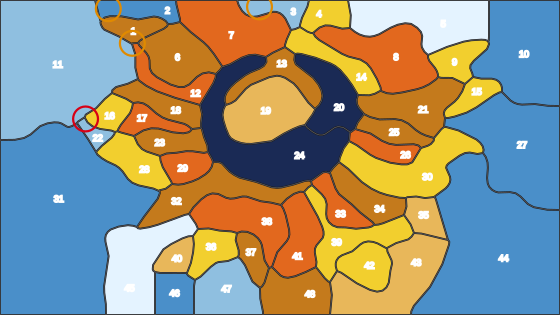
Choose the photo that looks most like them at a glance, not the one with the most detail. A slightly soft photo is fine. What matters is clear shapes: the line of a jaw, the shape of ears, the outline of a roof.
Names and dates
Letters are some of the hardest shapes to cut. An O or an A has a piece inside a piece, and most letters have sharp inside corners. If you want lettering in glass, make it large and in the border. Many makers paint or engrave names on a plain piece instead.
The checker flags the same problems in letters as anywhere else: see which cuts are impossible.
Frequently asked questions
Can I make a stained glass memorial from a photo of a person?
Yes. Faces work best simplified: keep the eyes, nose and outline, and let colour carry the rest. Use a lower piece count first.
Is the photo uploaded to your servers?
No. Everything runs in your browser; the photo never leaves your device.
Can I add a name or dates?
Yes, but letters are hard to cut. Keep them large and in the border, or paint or engrave them on a plain piece.
What size should a memorial panel be?
Whatever fits the space. Just set the real size before you check, because smaller panels need fewer, larger pieces to stay cuttable.
How much does it cost?
The preview and cut check are free. The printable packet is $5 with a Project Pass, or included with Lifetime.
The check is free. Pay once when you print.
No account and no card for the cut check. A Project Pass is $5 one-time for 30 days of printable pattern packets, with no subscription. Lifetime covers everything, forever.
Related
- A stained glass pattern of your dog or catDog and cat portraits: a pattern from your pet's photo, simplified for glass and checked for cutting.
- Make a stained glass pattern from a photoPhoto to pattern: choose a piece count, set the real size, fix flagged pieces, and print a full-size pattern.
- How do I make a stained glass pattern from a picture?Step by step from a photo to a cuttable, printable stained glass pattern, by hand or with a tool.
- Is my stained glass pattern cuttable?The free checker: drop a pattern and see which pieces can't be cut at your finished size, with one-click fixes.
- How do I print a stained glass pattern at actual size?Print at 100%, turn off fit to page, match the paper size, and measure the scale square before cutting.
- Copper foil or lead came: which should I use?Copper foil vs lead came: when to use each, line allowances, and how the method changes your pattern.